An online resource
Invasive BCI Chip Design
Jie Yang & Mohamad Sawan · Advanced Neural Chip Center, Westlake University
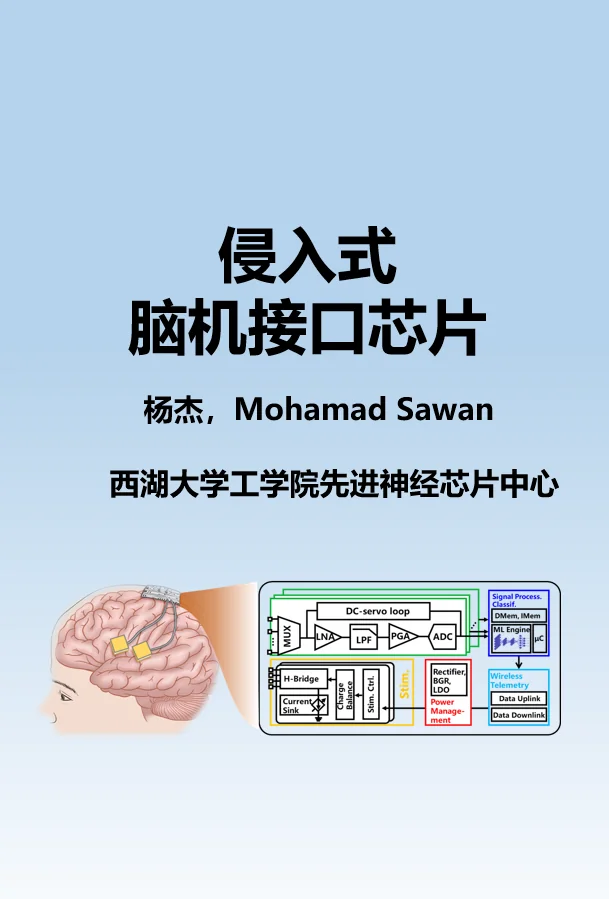
From electrodes to integrated systems
Invasive brain–computer interfaces establish a direct communication channel between neural tissue and electronic systems. Integrated circuits bring neural recording, signal processing, wireless communication, and stimulation into compact, low-power devices.
This resource introduces the key circuit modules behind these interfaces and their design trade-offs. It is intended for students and researchers entering the field.
Reading language: This overview and the bibliography are in English. The five full technical chapters are currently available in Chinese; each link below is labeled accordingly.
Technical chapters
Original Chinese textHow to cite
@book{yangjie_bci_2024,
  title = {Invasive Brain-Computer Interface Chip Design},
  author = {Jie Yang and Mohamad Sawan},
  year = {2024},
  note = {https://yangjie.ac.cn/book-item-bci_en.html}
}
Questions or corrections? Please write to yangjie@westlake.edu.cn.